
Stinging insects are a summer-into-fall hazard, and here it peaks late
Wasps and hornets are the pest that catches rural Northeast Wisconsin homeowners off guard, because the danger builds slowly and then arrives all at once. In May and June a paper wasp comb under the porch eave or a yellow jacket nest starting in the ground is small, quiet, and easy to walk past. Nobody calls in June. Then July and August roll through, the colonies swell, the workers get short-tempered, and suddenly a nest you never noticed is a genuine threat to anyone who gets near it. By late August and September, when the colonies are largest and most defensive, the calls come in a rush — somebody got stung mowing near a ground nest, or found a basketball-sized gray hornet nest hanging off the barn, or watched yellow jackets streaming in and out of a hole in the soffit right above the back door.
That late-season timing is the single most important thing to understand about stinging insects in this part of Wisconsin. Unlike a mouse problem that is worst in the cold months, wasps and hornets are a warm-season pest whose peak danger lands in the last stretch of summer and the first weeks of fall. Around Clintonville, Iola, Manawa, New London, Shawano, and Waupaca, on farms and in villages alike, the same curve plays out every year: build all summer, peak in late summer, and turn most aggressive right when families are still spending time outdoors.
BugBoss The X-Terminator handles stinging-insect work across Waupaca, Shawano, Outagamie, Waushara, Brown, and Winnebago counties, out of our shop at 600 S. Main St. in Clintonville. This page walks through the three insects you are most likely to deal with here, how their colonies grow through the season, why late summer is peak sting season, the sting and allergy risk, the wall-void danger that homeowners so often get wrong, nests on barns and outbuildings, why DIY so often backfires, and how we handle removal from start to confirmed finish. It pairs with our wasps and hornets pest-library page and our overall residential pest control approach.
Know which insect you have: paper wasp, yellow jacket, or bald-faced hornet
The three main players around here nest in completely different ways, defend their nests to different degrees, and call for different handling. Telling them apart is the starting point, because a treatment plan for an open paper wasp comb is not the plan for a ground colony of yellow jackets or a hornet nest hanging off the gable.
Paper wasps
Paper wasps are the ones most people picture when they think of a “wasp under the eave.” They build small, open, umbrella-shaped combs — a single layer of cells hanging from a short stalk, with the cells visible from below and no papery envelope around them. You find these combs under eaves and overhangs, on porch ceilings, under deck railings, inside grills, mailboxes, light fixtures, and the folds of patio umbrellas, and tucked into the sheltered corners of sheds and outbuildings. The wasps themselves are slender, long-legged, and often brownish or reddish with yellow markings, and they tend to dangle their legs in flight.
Of the three, paper wasps keep the smallest colonies and are the least aggressive — a paper wasp foraging in the garden is generally not looking for trouble. But that changes fast when you get near the nest. Because these combs are so often built exactly where people reach — a porch ceiling, a door frame, the grill you are about to open — accidental close encounters are common, and a defended paper wasp comb will sting. They are still far easier and safer to deal with than yellow jackets or hornets, especially early in the season while the nest is small.
Yellow jackets
Yellow jackets are the troublemakers of the group, and the ones behind most late-summer sting incidents. They are stocky, boldly banded black and yellow, and — unlike the leg-dangling paper wasp — they fly with their legs tucked up. Critically, they nest out of sight: in the ground, often in old rodent burrows or landscape voids, and in the wall voids, soffits, and cavities of buildings. That hidden nesting is what makes them so dangerous, because you often do not know the nest is there until you are right on top of it. A person mowing the lawn, pulling weeds, or splitting wood can put a foot or a mower over a ground nest entrance and bring the whole colony out.
Yellow jacket colonies are also the largest. Starting from a single overwintered queen in spring, a colony grows all summer and can reach hundreds to several thousand workers by August. They are aggressive in defense of the nest, they can sting repeatedly, and in late summer they become the notorious scavengers that swarm your food, sweet drinks, fruit, and garbage. A big yellow jacket colony in a wall void or soffit right by a doorway is one of the higher-stakes stinging-insect situations we get called for, and it is one you should never try to seal shut on your own — more on that below.
Bald-faced hornets
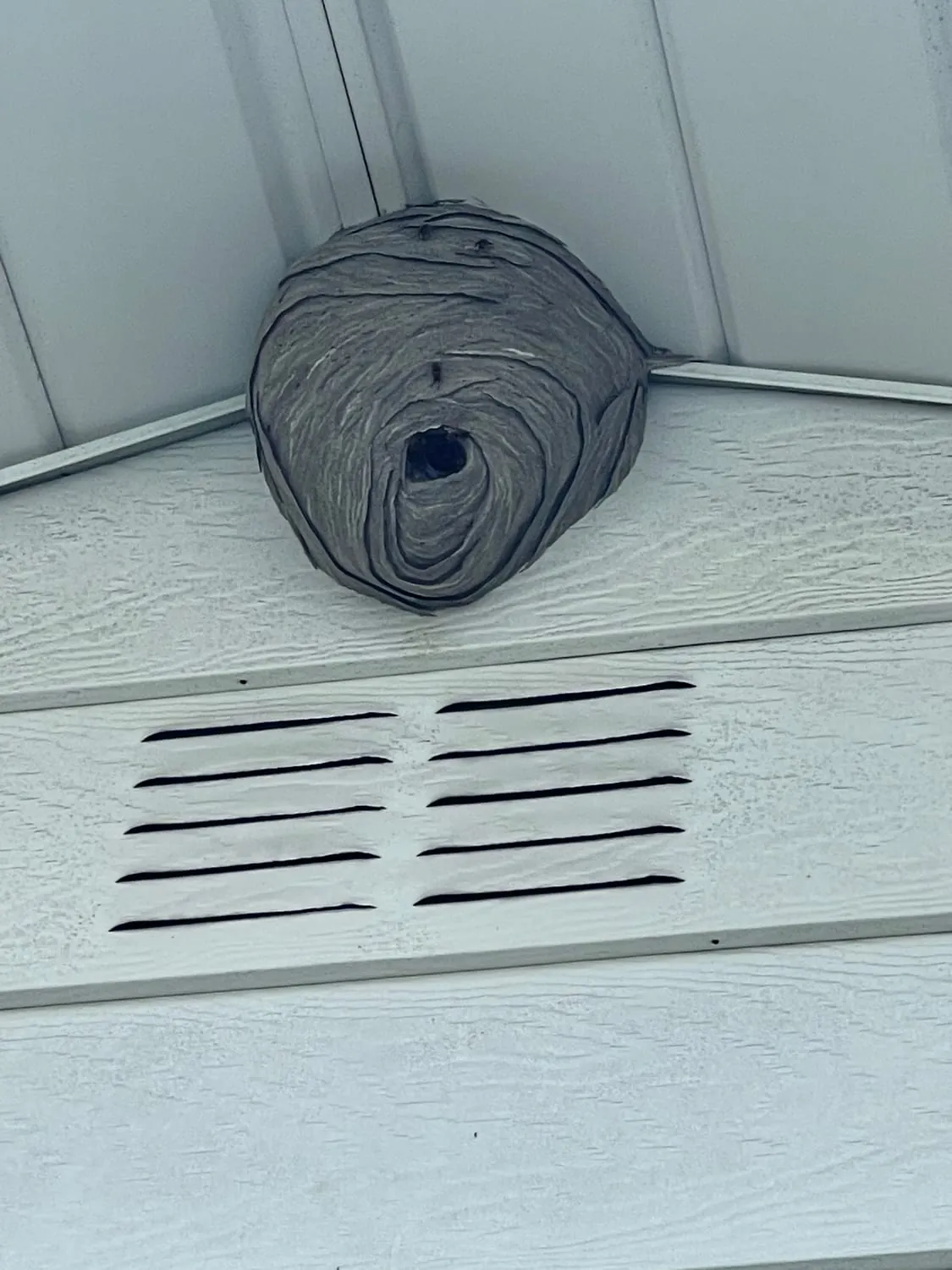
Bald-faced hornets — actually a large type of yellow jacket, despite the name — build the nest everyone recognizes: the big, gray, enclosed paper nest, shaped like a football or a basketball, hanging from a tree branch, a shrub, or the side of a building, or tucked under an eave or in a barn peak. Unlike the open paper wasp comb, this nest is fully enclosed in a papery envelope with a single entrance near the bottom, and the combs of brood are hidden inside. The hornets themselves are large and black with an ivory-white face and white markings, noticeably bigger than a yellow jacket.
Bald-faced hornets defend that enclosed nest fiercely, and because the nest can be large and is often up high — in a tree, on a gable, on the upper wall of a barn — they are among the more intimidating nests to deal with. They can sting repeatedly, and disturbing the nest brings out defenders in numbers. A hornet nest hanging where people pass, over a doorway, near a deck, or low in a tree kids climb, is a nest that needs professional removal, not a can of spray and a hope.
The colony growth curve: why late summer is peak sting season
To understand why the danger lands so hard in late summer, it helps to follow a colony through the year. All three of these insects follow the same annual pattern in Wisconsin, and knowing it tells you when to act.
In spring, a single fertilized queen who overwintered in a sheltered spot — under bark, in a woodpile, in a wall or attic — emerges and starts a nest alone. She builds a small starter nest, lays the first eggs, and raises the first batch of workers herself. Through late spring this founding nest is small and vulnerable, defended only by the queen. This is the easiest and safest window to deal with a nest, because there is so little to it.
Through summer, those first workers take over foraging and nest expansion while the queen shifts to full-time egg-laying. Now the colony compounds. Each new batch of workers means more foragers, more building, and faster growth, so the nest expands steadily through June and July. For yellow jackets and hornets, a nest that was the size of a golf ball in May can be the size of a soccer ball or bigger by August, holding hundreds to thousands of individuals. Through most of the summer the workers are largely hunting other insects to feed the brood, which keeps them busy and out in the fields and gardens rather than crowding your picnic.
Then comes late summer, and the whole dynamic shifts. The colony hits its maximum size just as the queen slows and eventually stops laying. The brood shrinks, so the workers no longer need to hunt protein — and they switch to craving sugars and carbohydrates. That is the switch that sends yellow jackets to your soda cans, grilled food, fruit trees, and trash cans in August and September. At the same time, natural food is getting scarcer, the colony is at peak population, and the workers are increasingly defensive of a nest that now represents a whole season’s investment. Peak numbers, short tempers, and scavenging behavior all arrive together. That is why August into September is peak sting season here, and why the calls surge in the last weeks of summer.
In fall, the colony produces new queens and males, which leave to mate. The new queens find sheltered spots to overwinter, and the old colony — the founding queen and all those workers — dies off with the cold. The nest is not reused. This is why an old bald-faced hornet nest hanging in a bare tree in December is empty, and why the problem resets to a single queen again the following spring. It also means that a nest discovered very late in the season may be near the end of its natural life anyway — but a large, active, well-placed nest in August is at its most dangerous and should not be left to run its course near where people live and work.
Sting risk and who is most vulnerable
For most healthy people, a single sting from a wasp, yellow jacket, or hornet is painful but not dangerous — sharp pain, redness, and localized swelling that eases over a few hours to a day. What makes stinging insects a real safety concern rather than just a nuisance is two things: the people who are allergic, and the colonies that deliver many stings at once.
People with a venom allergy face the serious risk. A severe allergic reaction — anaphylaxis — can involve swelling spreading beyond the sting site, hives, difficulty breathing, throat tightness, dizziness, nausea, and a dangerous drop in blood pressure, and it can come on within minutes. This is a medical emergency. Anyone showing signs of a severe allergic reaction needs emergency care right away, and a person with a known severe allergy should use their prescribed epinephrine auto-injector and call for help without waiting to see how bad it gets. If someone in your household is allergic, a nest near the house is not something to gamble on — it is a reason to get professional removal promptly and safely.
The other risk applies to everyone, allergic or not: multiple stings. Unlike a honeybee, which stings once and dies, wasps, yellow jackets, and hornets can sting repeatedly, and disturbing a colony brings out many defenders at once. A person who steps on a yellow jacket ground nest or knocks a hornet nest can take dozens of stings in seconds. Even for someone with no allergy, a large number of stings is a genuine medical concern. This is exactly the scenario a botched DIY attempt can create, and it is why hidden ground and void colonies are so hazardous — the danger is out of sight until it is all around you.
Children, older adults, and pets are also more vulnerable, both because they may not recognize a nest and because they can stumble into one — a ground nest at the edge of the yard, a nest in a playset or a shrub, a paper wasp comb inside a mailbox or grill. Late summer, when the colonies are biggest and the yellow jackets are scavenging around food and drinks, is when these accidental encounters spike.
The wall-void and soffit danger: never seal a colony from the outside
Of everything on this page, this is the point to take away if you take away only one: if wasps or yellow jackets are living inside a wall void or soffit, never seal the outside entrance while the colony is alive. It is the most common serious mistake homeowners make, and it turns an outdoor problem into an indoor one.
Here is what happens. You notice yellow jackets streaming in and out of a small gap — where the soffit meets the wall, a crack in the siding, a hole around a vent or utility line — and the obvious instinct is to plug that hole and cut them off. But the nest itself is inside the void, and the wasps do not simply give up and die when their front door is blocked. They look for another way out. Behind a soffit or inside a wall, the path of least resistance often leads inward, not outward — the wasps chew through drywall, follow gaps around outlets, light fixtures, and ceiling penetrations, and end up emerging inside your living space. Now you have a colony of agitated wasps in the house instead of outside it, and people who thought they had solved the problem find wasps coming out of the walls in the bedrooms.
The correct sequence is always the same, and it is not negotiable: treat and eliminate the colony first, confirm it is dead, and only then seal the entry point to keep anything from re-nesting there. Treating a void colony properly means getting the product to where the colony actually is, so that the workers contact it and the nest dies out — and only once we are certain nothing is left alive inside do we, or you, close up the gap. Sealing is the last step, never the first. This void-colony work is precisely the kind of hidden, higher-stakes situation BugBoss is set up to handle, and it is a big part of why calling a professional for a wall or soffit colony is worth it.
The same logic applies to a ground colony near a foundation or a nest tucked into the structure of a porch or deck: the goal is to eliminate the colony where it lives, not to trap it somewhere it will fight its way toward you. Getting the order wrong is how a manageable outdoor nest becomes a scary indoor one.
Nests on homes, barns, and outbuildings, and reaching them safely
Around here, stinging insects are not just a house problem — they are very much a barn and outbuilding problem, and that is where a lot of our work happens. Farms, pole barns, sheds, machine sheds, and old outbuildings offer nearly unlimited sheltered nesting spots: open soffits and eaves, high peaks and gable ends, rafters and purlins, gaps in barn board and siding, and the countless small openings that older rural construction accumulates. A bald-faced hornet nest hanging from a barn peak, a paper wasp colony under a shed eave, or yellow jackets in the soffit of a pole barn are everyday finds on rural property.
What makes these nests so hazardous for homeowners is the combination of height, awkward access, and defensive colonies. Reaching a nest high on a gable, in a barn peak, or in a tall pole-barn soffit usually means a ladder, and a ladder next to an active hornet or yellow jacket colony is a genuinely dangerous place to be. The natural reaction to a swarm of stinging insects — flinching, swatting, scrambling to get away — is exactly what you do not want to be doing at the top of an extension ladder. Every year people are hurt not just by the stings but by the fall.
Safely reaching high and hidden nests is a core part of what we do across the rural Clintonville area. We come with the right equipment, the right products, and an approach designed to reach the colony while managing its defensive response, so the nest is eliminated without anyone ending up exposed on a ladder next to it. Barns, pole barns, and outbuildings are some of the most common structures we treat precisely because they are so full of nesting sites and so awkward and risky for a homeowner to handle. If you have a nest on an outbuilding, on the upper walls or peak of the house, or high in a tree over an area people use, that is a job worth handing off.
Why DIY sprays are dangerous and often fail
The hardware-store wasp spray is one of the most-purchased pest products every summer, and for a small, exposed paper wasp comb you can safely reach from the ground, it sometimes does the job. For anything larger or hidden, though, DIY runs into two problems that regularly turn a nest into a worse situation: it often does not reach the whole colony, and the part it does reach it enrages.
Coverage is the first problem. A can of aerosol hits the surface of a nest or the workers you can see, but the queen and the developing brood deep inside an enclosed hornet nest, down a ground burrow, or back in a wall void frequently survive. As long as the queen lives, the colony rebuilds. So the common result of a DIY spray on a big nest is a colony that is knocked back for a day, then recovers — except now it is a defensive, agitated colony that has learned there is a threat at that spot. Ground and void colonies are especially likely to shrug off a surface spray, because the actual nest is somewhere the spray never reaches.
Provocation is the second, and more dangerous, problem. The instant you spray, every worker that contacts the disturbance, and every forager that comes home to it, goes into full defense. Yellow jackets and hornets sting repeatedly, they release alarm signals that summon the rest of the colony, and they will pursue a threat well away from the nest. A homeowner who sprays a big yellow jacket or hornet nest and then has to retreat — often down a ladder, often with wasps in pursuit — is in exactly the situation that produces multiple stings and falls. If anyone in the household is allergic, the stakes are higher still.
There is also the matter of not knowing the full picture. A homeowner sees the entrance and the workers; a professional recognizes when that entrance leads to a large void colony, a nest that must not be sealed, or a situation where the safe approach is not obvious from the outside. Getting a stinging-insect problem wrong is not like getting an ant problem wrong — the feedback is immediate and it stings. Professional treatment is built around reaching the whole colony while controlling that defensive response, which is the difference between a nest that dies out and a nest that fights back.
The BugBoss removal process
We approach stinging-insect work as a job with a clear beginning and a confirmed end, not a quick spray-and-leave. Here is how it goes.
First, we identify and locate. We confirm which insect you are dealing with — paper wasp, yellow jacket, or bald-faced hornet — because the three nest differently and are treated differently, and we find where the nest actually is. That last part matters most with the hidden nesters: following yellow jacket traffic back to a ground entrance, a wall void, or a soffit cavity tells us where the colony really lives, which is where the treatment has to reach. A visible nest is straightforward; a void or ground colony takes locating.
Second, we treat the colony at its source, with the method suited to the situation and with the safety of your household and our applicator front of mind. For an exposed paper wasp comb or an accessible enclosed nest, that means treating and removing the nest directly. For a ground colony, it means getting the product into the nest itself. For a wall-void or soffit colony, it means treating so the workers carry the product through the nest and contact it — and, crucially, leaving the entrance open until the colony is confirmed dead, never sealing a live colony inside where it can chew its way into the living space. High and hard-to-reach nests on homes, barns, and outbuildings are handled with the equipment and approach to do it safely, without leaving anyone exposed on a ladder next to an active colony.
Third, we confirm the colony is actually dead before we call the job done. This is the step DIY and spray-and-run services skip. A properly treated nest usually dies off within a day or two — fast for paper wasps and exposed nests, and a little longer for yellow jacket and hornet colonies where returning foragers need to contact the treatment. Large ground colonies and deep void colonies sometimes need a follow-up to be sure nothing survived. We do not treat a drop in visible activity as proof of success; we confirm the colony is gone.
Finally, for void colonies, sealing comes last. Once we are certain the colony inside a wall or soffit is dead, closing the entry point keeps a new queen from re-nesting in the same spot next spring, and we advise on the soffit and siding gaps worth sealing to cut down on repeat nesting. Everything runs through our residential pest control service, we are licensed and insured, and there is no long-term contract — you get a free up-front quote and you deal directly with the owner, Brian. It is all backed by our guarantee.
Prevention and reducing re-nesting
You will never make a rural property in Northeast Wisconsin wasp-free — there are simply too many sheltered nesting spots and too many overwintered queens looking for a home each spring. But you can meaningfully reduce how much stinging-insect activity you deal with, and the effort pays off most if you get ahead of the season rather than reacting to a big August nest.
The most effective single habit is catching nests while they are small. Early in the season, walk the sheltered spots where nests start — under eaves and overhangs, porch ceilings, deck railings, inside grills and mailboxes, in playsets, and around the soffits and peaks of sheds and outbuildings. A paper wasp starter nest is a tiny open comb defended by a single queen, and knocking down that small early nest, in a spot you can safely reach, is far less risky than dealing with the mature colony it would become by August. Keep checking through the summer, because new nests start at different times and a spot that was clear in June can have a comb by July.
Sealing is the other pillar, and it does double duty. Closing the gaps that let wasps into wall and soffit voids — where the soffit meets the fascia, cracks in siding, worn spots around vents and utility penetrations — keeps queens from establishing hidden colonies in the first place, and it is the same sealing work that helps against fall invaders and other pests. On pole barns and outbuildings, capping open ends and closing gaps in the construction removes a lot of the sheltered nesting sites that make those buildings such reliable wasp habitat. Just remember the rule: seal empty spots to prevent nesting, but never seal an active colony inside — treat first, confirm it is dead, then close it up.
Finally, in late summer, deny the scavengers an easy meal. When yellow jackets switch to craving sugar and carbohydrates in August and September, keep outdoor food and sweet drinks covered, clean up spills promptly, keep garbage and recycling sealed, rinse containers before they go in the bin, and manage fallen fruit under trees. This will not remove a nest, but it cuts down on the scavenging pressure around your deck, patio, and picnic table at the exact time of year when yellow jackets are most numerous and most defensive. The lasting fix for a nest is still removal — but reducing the food that draws foragers makes the outdoor spaces more usable while you get the nest handled.
When to call BugBoss
Call as soon as you find an active nest near where people spend time — a nest over or near a doorway, on the deck or porch, low in a tree, in a playset, or anywhere in the paths you use every day. Do not wait for the colony to hit its late-summer peak; a nest is easiest and safest to handle earlier, and it only gets bigger and more defensive as the season goes on. Call right away for any yellow jacket ground nest in the yard, any wall-void or soffit colony, and any bald-faced hornet nest, and call before anyone tries to seal a hole that wasps are using — that is the moment to get a professional involved, not after the colony has been driven inside.
Call without hesitation if anyone in the household is allergic. A nest near the house is a standing risk to an allergic family member, and it is not worth a DIY gamble. And call for the nests that are simply out of reach or too dangerous to approach — high on the house, on a barn or pole-barn peak, in a soffit, or high in a tree — where the real hazard is as much the ladder and the fall as the stings.
This is a place where a local company earns its keep. Stinging-insect work is hands-on, situation-specific, and genuinely hazardous, and it rewards someone who knows the local building stock — the older farmhouses, barns, and outbuildings around Clintonville, Iola, Manawa, New London, Shawano, and Waupaca, with all their sheltered nooks and hidden voids. BugBoss is family-owned and based right here at 600 S. Main St. in Clintonville, so response across the surrounding farm country is fast and local, and we handle the whole picture — paper wasps under the eaves, yellow jackets in the ground and the walls, and bald-faced hornets on the barn — safely, and confirmed done. If you are also dealing with spiders that follow the insects, or want the house covered more broadly, our general pest control service ties it together, and we handle wildlife too.
Reach us at 866-BUGBOSS (866-284-2677), or request a free quote. Local, licensed, insured, no contract — and the colony confirmed gone before we call it done. We serve Clintonville and the surrounding rural counties.